Oct. 20, 2026
As the cosmetics packaging industry continues to evolve, consumers expect more than basic sealing performance. Ease of use, controlled dispensing, and clean packaging are becoming increasingly important. Plastic squeeze tubes are widely used for facial cleansers, face creams, eye creams, and skincare gels due to their lightweight design, portability, and ease of use.
Traditional tube caps may allow product residue, dripping, or inconsistent dispensing. A flip top cap with valve combines a plastic cap with a one-way valve to provide controlled dispensing and automatic closure, offering a functional packaging solution for cosmetic squeeze tubes.
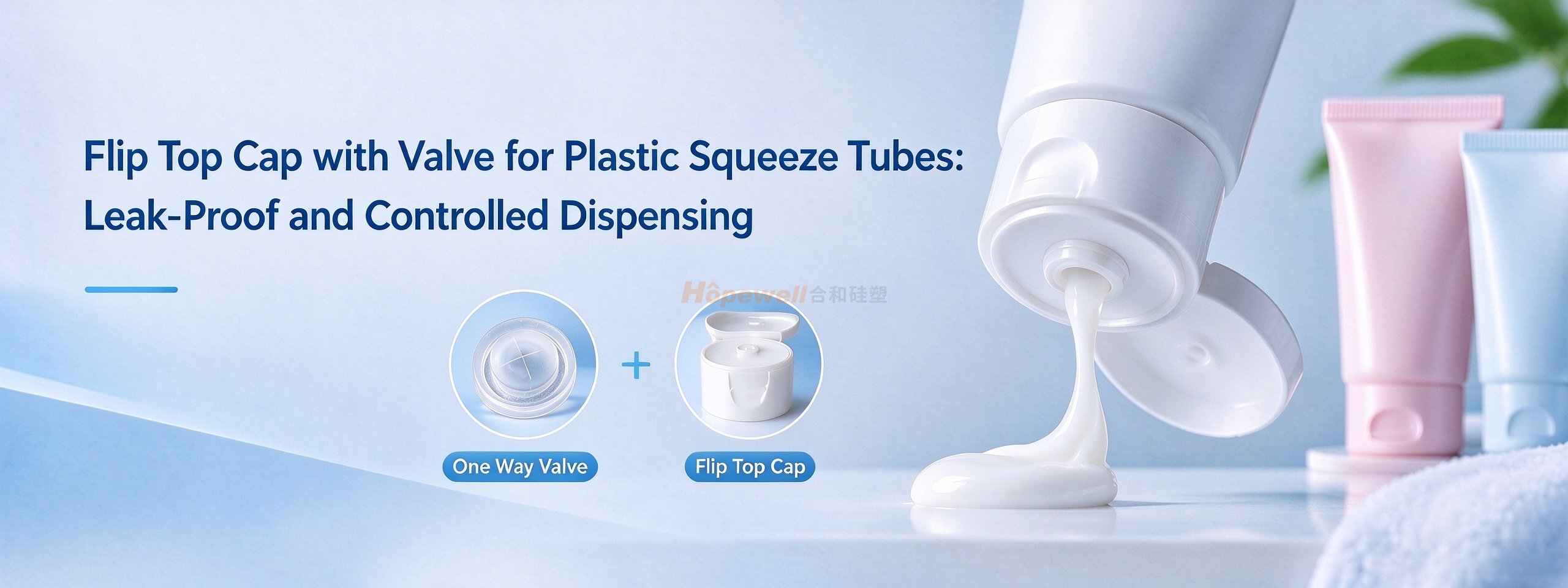
A flip top cap with valve is a functional packaging closure consisting of a plastic cap and a one-way valve. The plastic cap provides the connection and support, while the valve controls product flow and helps seal the dispensing outlet after use.
When the tube is squeezed, the internal pressure opens the valve, allowing the product to flow out. Once squeezing stops, the elastic valve returns to its closed position, helping reduce continued product flow and dripping.
The valve can be customized by adjusting the material, hardness, slit shape, and slit cut size to accommodate different product viscosities and dispensing requirements.
Plastic squeeze tubes, typically made from plastic or laminated materials, are flexible, lightweight, and easy to dispense from. They are widely used in cosmetics and personal care packaging.
A flip top cap with valve can be designed for various applications based on product characteristics.
Helps control product flow and reduce dripping after squeezing, keeping the dispensing outlet cleaner.
Optimized valve openings and slit designs help improve dispensing performance for thicker formulations and enhance ease of use.
Supports more controlled dispensing and helps minimize product residue, making it suitable for products requiring precise application.
Valve structures can be tailored to the flow characteristics of different formulations, balancing smooth dispensing with reliable closure.
Since different products require different opening pressures, flow rates, and sealing performance, valve design should be matched to the specific formulation and application.
The silicone valve automatically returns to its closed position when squeezing stops, helping reduce continuous product flow and dripping. This helps keep the packaging cleaner during use. Actual leak-prevention performance depends on the valve design, cap fit, and usage conditions.
By adjusting the valve opening, slit shape, material and hardness, manufacturers can optimize opening pressure and flow rate to suit different cosmetic formulations and dispensing requirements.
The one-way valve restricts reverse product flow and helps reduce the risk of external contaminants entering through the dispensing outlet, providing an additional level of protection during use.
The valve can be customized in terms of material, hardness, slit size, and slit shape. The cap structure can also be adapted to the tube dimensions and connection requirements to meet different cosmetic packaging needs.
Traditional orifice caps feature a simple structure and are generally suitable for standard dispensing applications. A flip top cap with valve offers additional functionality for flow control, automatic closure, and drip reduction.
Comparison | Flip Top Cap with Valve | Traditional Orifice Cap |
| Dispensing method | Pressure-activated dispensing with automatic valve closure | Product flows through an open dispensing hole |
| Drip prevention | Helps reduce continued flow and dripping | Depends mainly on the orifice size and cap design |
| Backflow control | Helps restrict reverse flow | Generally lacks dedicated one-way flow control |
| Flow adjustment | Can be optimized through valve design | Primarily controlled by orifice size and squeezing pressure |
| User experience | Supports convenient dispensing with reduced need for manual closure | Depends on the cap design; some types require manual opening and closing |
Overall, traditional orifice caps are suitable for standard dispensing needs, while flip top caps with valves are worth considering for cosmetic packaging that requires improved drip control, backflow restriction, and dispensing convenience.
Selecting the right flip top cap with valve requires careful consideration of several factors.
Product Characteristics: Choose a suitable valve structure based on the viscosity, formulation, and flow behavior of the cream, lotion, or gel.
Dispensing Requirements: Define the desired flow rate, dispensing pressure, drip-prevention performance, and portion control requirements.
Material Compatibility: Evaluate the compatibility of the one way valve with the cosmetic formulation and conduct relevant testing when necessary.
Dimensions and Fit: Confirm the cap dimensions, tube specifications, and connection method to ensure proper installation and fit.
Performance Testing: Conduct dispensing, leakage, backflow, and repeated-use tests to verify that the cap meets the intended application requirements.
As consumer expectations continue to rise, cosmetic tube packaging is evolving toward more functional and user-friendly designs. With its one-way dispensing mechanism and automatic closure, a flip top cap with valve provides a versatile packaging option for facial cleansers, face creams, eye creams, and skincare gels.
For cosmetic brands and packaging manufacturers, selecting the appropriate valve structure and materials can help improve dispensing performance, reduce dripping, and enhance packaging practicality.
As demand for functional packaging continues to grow, flip top caps with valves offer new opportunities to optimize and innovate cosmetic squeeze tube packaging.
Latest Post
Flip Top Cap with Valve for Plastic Squeeze Tubes: Leak Proof and Controlled Dispensing
Published on Oct. 20, 2026
Spout Bottle Cap with Valve: Improving Packaging with Leak-Proof and Precision Dispensing
Published on Sep. 08, 2026
Flip Top Valve Caps: Enhancing Dispensing Performance in Soft Packaging Applications
Published on Aug. 19, 2026
How to Choose the Right Size of Plastic Cap with Valve for Your Bottle
Published on Jul. 14, 2026
5 Reasons Ketchup Brands Switch to Silicone Valve Dispensing Closures
Published on Jun. 03, 2026

Snap Top Dispensing Cap: The Next Generation No Drip Solution for Honey and Food Packaging in 2026
Published on May. 08, 2026
How Do Dispensing Caps Prevent Leakage?
Published on Apr. 13, 2026
Inverted No-Flip Top Caps: A New Trend in Kitchen Cleaning Product Packaging
Published on Mar. 11, 2026
Differences Between Silicone Dispensing Valve from Different Suppliers
Published on Feb. 04, 2026
One-Way Cross-Slit Valve: Redefining Sealing and Dispensing Standards for Detergent Bottle Caps
Published on Jan. 07, 2026
Navigation
Get in Touch
Mob.: +86 151 1847 9234
E-mail: rosie@siliconinjection.com
Skype: rosie@siliconinjection.com
WhatsApp: +86 151 1847 9234