Nov. 12, 2026
As LED lighting technology continues to advance, underwater lighting systems are evolving toward higher brightness, longer service life, greater reliability, and more sophisticated optical designs.
From swimming pool lighting and landscape fountains to aquariums, marine lighting, and underwater engineering applications, manufacturers are placing increasingly demanding requirements on optical materials, including light transmission, environmental resistance, and long-term performance stability.
Traditionally, PMMA (acrylic) and PC (polycarbonate) have been widely used in underwater lighting lenses. While these conventional materials offer good optical transparency and well-established manufacturing processes, prolonged exposure to UV radiation, temperature fluctuations, and demanding outdoor environments may cause certain products to experience cracking, yellowing, or material aging, potentially affecting lighting performance and product lifespan.
To address these challenges, optical silicone reflector offer an alternative material solution for underwater lighting applications. With excellent light transmission, outstanding resistance to yellowing, good high-temperature resistance, and superior flexibility, optical-grade liquid silicone provides new possibilities for improving the durability and reliability of underwater lighting products.
Furthermore, the elasticity and design flexibility of optical liquid silicone materials allow manufacturers to explore more versatile structural designs and customized optical solutions.
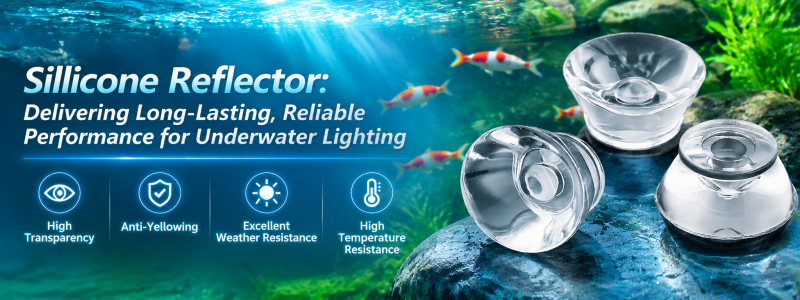
An optical silicone reflector is an optical component manufactured using optical-grade liquid silicone rubber (LSR) through precision tooling and Liquid Silicone Rubber Injection Molding.
It is primarily designed to transmit, refract, focus, and control the beam angle of LED light, helping achieve the desired lighting distribution and optical performance.
Unlike conventional industrial-grade silicone, optical-grade LSR has more stringent requirements for material purity, light transmittance, haze, refractive index, and molding quality.
By optimizing mold structures and injection molding parameters, manufacturers can produce customized silicone optical lenses in different sizes, shapes, thicknesses, and optical profiles to meet specific lighting design requirements.
In underwater lighting applications, silicone lenses not only control light transmission and distribution but also offer additional design flexibility. Their inherent elasticity and flexibility can provide more possibilities for structural integration and sealing design between the lens and lighting housing.
Compared with conventional rigid PMMA and PC lenses, optical silicone reflectors offer several distinctive advantages in terms of flexibility, resistance to yellowing, thermal stability, and environmental durability.
High-quality optical liquid silicone offers excellent light transmission, allowing LED light to pass through efficiently while minimizing unnecessary optical losses.
By carefully optimizing lens thickness, surface curvature, and optical geometry, silicone lenses can be designed to meet different requirements for brightness, beam angles, and light distribution.
This makes optical silicone a suitable material choice for underwater lighting products that require consistent optical performance.
One of the most significant advantages of silicone reflector over conventional rigid plastic lenses is their flexibility.
PMMA and PC lenses are relatively rigid materials. Under external impact, assembly stress, or temperature fluctuations, certain designs may develop cracks or suffer physical damage. Thin sections and areas with concentrated stress can be particularly vulnerable.
In contrast, silicone materials feature excellent elasticity and flexibility. When exposed to external impact, compression, or assembly stress, silicone can deform and recover to a certain extent, helping absorb mechanical stress and reduce the risk of brittle cracking.
For underwater lighting equipment operating in demanding environments, maintaining the structural integrity of optical components is essential.
The flexibility of silicone reflectors provides manufacturers with a more adaptable material option for improving product reliability and reducing potential damage caused by mechanical stress.
Yellowing is a common concern for transparent optical materials exposed to prolonged operating conditions.
Continuous exposure to UV radiation, heat generated by LED light sources, and environmental factors may cause certain PMMA and PC materials to change color over time, potentially reducing light transmission and affecting overall illumination quality.
High-quality optical silicone offers excellent resistance to yellowing and aging, helping reduce the risk of discoloration during long-term use.
For underwater lighting systems designed for extended operation, yellowing resistance is important not only for maintaining product appearance but also for preserving optical transparency and lighting performance.
LED lighting systems generate heat during operation. This is particularly important for high-power underwater lighting equipment, where optical materials must withstand continuous thermal exposure.
Optical silicone features good thermal stability and a wide operating temperature range. It can withstand certain levels of continuous high-temperature exposure and temperature fluctuations, helping reduce the risk of performance degradation caused by thermal aging.
This makes silicone reflectors a promising option for lighting applications with demanding thermal requirements.
Underwater lighting products are frequently installed outdoors, where they may be exposed to UV radiation, humidity, heat, and changing weather conditions.
Optical liquid silicone offers good UV resistance, moisture and heat resistance, and environmental adaptability.
Compared with certain conventional plastic materials, optical-grade liquid silicone provides advantages in long-term outdoor applications, helping maintain material stability and product performance under demanding environmental conditions.
PMMA and PC have been widely used in LED underwater lighting for many years. Both materials offer specific advantages, but as lighting manufacturers increasingly focus on product lifespan and reliability, some limitations of conventional plastic lenses have become more noticeable.
PMMA offers excellent optical transparency and mature manufacturing technology. However, it is relatively rigid and has limited flexibility.
When exposed to external impact, assembly stress, or temperature fluctuations, PMMA lenses may be vulnerable to cracking or physical damage.
Long-term exposure to UV radiation and environmental conditions may also affect material aging and optical performance.
PC offers good impact resistance, mechanical strength, and processing characteristics.
However, certain PC materials may experience yellowing, aging, and reduced light transmission after prolonged exposure to UV radiation and high temperatures.
UV-resistant additives or surface treatments can improve certain properties, but material selection should always be based on the actual operating environment.
For underwater lighting equipment, lens damage can create problems beyond appearance and optical performance. Cracks may compromise the original waterproof structure of the lighting fixture, increasing the risk of water ingress and potentially affecting internal electronic components.
Similarly, yellowing and material aging may cause light attenuation, color shifts, and reduced illumination performance, resulting in additional maintenance and replacement costs.
Therefore, underwater lighting manufacturers need more than just a transparent optical material. They need a solution that combines optical performance, mechanical flexibility, thermal resistance, and long-term environmental stability.
Optical silicone reflectors offer an alternative approach to addressing these requirements, helping manufacturers optimize product structures and reduce potential risks associated with cracking and long-term material degradation.
Common optical materials used in underwater lighting include optical silicone, PMMA (acrylic), PC (polycarbonate), and glass.
Each material has its own advantages and limitations in terms of optical performance, mechanical properties, weather resistance, manufacturing processes, and cost.
The following comparison provides an overview to help lighting manufacturers select the most suitable material for their applications.
Comparison | Silicone Lens | PMMA Lens | PC Lens | Glass Lens |
Light Transmittance | Excellent | Excellent | Good to Excellent | Excellent |
Yellowing Resistance | Excellent | UV aging should be considered | UV aging should be considered | Excellent |
High-Temperature Resistance | Excellent | Relatively Low | Good | Excellent |
Flexibility | Excellent | Low | Low | None |
Impact Characteristics | Soft and Elastic | Relatively Limited | Excellent | Relatively Limited |
Weather Resistance | Excellent | Depends on material and environment | UV protection may be required | Excellent |
Manufacturing Process | LSR Injection Molding | Injection Molding | Injection Molding | Pressing and Precision Optical Processing |
Cost Level | Medium to High | Low | Medium | Generally High |
PMMA lenses offer excellent optical transparency and mature processing technology. Their raw material and manufacturing costs are relatively low, making them a common choice for traditional LED lighting products.
However, PMMA is a rigid plastic with limited flexibility. External impact, assembly stress, and temperature fluctuations may increase the risk of cracking or breakage.
For long-term outdoor applications, UV exposure and environmental aging should also be considered.
PC lenses offer good impact resistance, mechanical strength, and established manufacturing processes. Their overall production costs are generally moderate.
However, certain PC materials may experience yellowing, aging, and reduced optical performance after prolonged exposure to UV radiation and high temperatures.
UV-resistant additives and surface treatments can help improve certain properties, but the final material selection should be based on actual application requirements.
Glass lenses provide excellent optical stability, high-temperature resistance, and scratch resistance, making them suitable for precision optical applications.
However, glass is inherently brittle and may break under significant impact.
Precision glass lenses also require specialized manufacturing processes and strict dimensional and surface quality control. As a result, their overall manufacturing costs are generally higher, and their weight is also relatively greater.
The main advantage of optical silicone reflectors is their combination of good light transmission, excellent flexibility, yellowing resistance, high-temperature resistance, and weather resistance.
Compared with rigid PMMA and PC lenses, silicone offers greater elasticity and flexibility. When subjected to external impact or assembly stress, it can provide a certain degree of cushioning through elastic deformation, helping reduce the risk of brittle cracking.
High-quality optical silicone also offers good resistance to yellowing and aging, making it suitable for lighting applications where long-term optical stability is important.
In terms of cost, silicone reflectors are not designed to compete solely on the lowest initial material price. Instead, their improved material properties can contribute to product durability, reliability, and long-term performance.
Although the initial material and manufacturing costs of silicone reflectors may be higher than those of conventional PMMA lenses, their flexibility, yellowing resistance, and environmental adaptability may help reduce potential maintenance and replacement costs associated with cracking, discoloration, and aging.
Ultimately, there is no single best material for every application.
PMMA and PC: Suitable for applications where initial material cost and established manufacturing processes are important considerations.
Glass: Worth considering for applications requiring excellent optical stability, high-temperature resistance, and scratch resistance.
Optical Silicone: A promising choice for underwater lighting products that prioritize flexibility, yellowing resistance, thermal stability, and long-term environmental durability.
The right choice depends on the actual operating environment, product design, performance requirements, and overall cost considerations.
As the LED underwater lighting market continues to develop, manufacturers are paying increasing attention not only to initial lighting performance but also to long-term product stability, reliability, and maintenance costs.
Optical silicone reflectors provide a new material option for applications traditionally using rigid plastic lenses.
Swimming Pool Lighting
Silicone reflectors offer good light transmission, yellowing resistance, and environmental adaptability, making them a suitable material option for swimming pool lighting systems that require reliable long-term performance.
Landscape Fountains and Outdoor Water Features
With good weather resistance and UV resistance, optical liquid silicone can help address the environmental challenges associated with outdoor landscape and fountain lighting.
Aquarium Lighting
Customized silicone reflectors can be developed according to specific optical and structural requirements for aquarium lighting equipment.
Marine and Specialized Underwater Lighting
For marine lighting, underwater engineering, and other specialized lighting applications, silicone reflectors offer flexibility in material selection and customized optical design.
Looking ahead, underwater lighting products are expected to place greater emphasis on long-term material reliability, integrated product structures, and customized optical components.
With continued improvements in optical-grade liquid silicone formulations, precision mold design, and liquid silicone rubber molding technology, silicone reflectors have the potential to serve an increasingly broad range of high-reliability lighting applications.
Different underwater lighting products have different requirements for dimensions, beam angles, light transmission, operating temperatures, and installation structures.
Standard optical components may not always meet these specific design requirements.
To support different product development needs, we provide custom silicone reflector development based on customer-supplied 2D engineering drawings and 3D design files.
From material selection and structural evaluation to mold design and sample production, we can customize silicone reflectors according to specific application requirements.
Whether you are looking to replace traditional PMMA or PC lenses or develop entirely new optical components for underwater lighting, we can provide customized solutions based on your engineering drawings and product specifications.
During the development process, we focus on matching material properties with product structures. Depending on project requirements, we can evaluate light transmittance, haze, yellowing resistance, temperature resistance, and dimensional stability to help transform your design concepts into practical silicone optical components.
The transition from traditional PMMA and PC lenses to optical silicone reflectors represents more than just a change in material selection. It reflects the growing demand for longer-lasting, more reliable, and more sophisticated underwater lighting products.
With excellent light transmission, superior flexibility, good yellowing resistance, high-temperature resistance, and weather resistance, silicone reflectors provide an alternative to conventional rigid optical materials.
As a silicone product manufacturer, we continue to follow developments in optical silicone materials and precision molding technologies. Through our manufacturing expertise and customized product development capabilities, we aim to provide silicone lens solutions that meet the specific requirements of different underwater lighting applications.
Looking for a reliable custom Silicone Reflector or optical silicone lens manufacturer? Contact us today and share your 2D drawings, 3D files, or product requirements. Our team will be glad to discuss your project and provide a customized solution.
Latest Post
Silicone Reflector: Delivering Long-Lasting, Reliable Performance for Underwater Lighting
Published on Nov. 12, 2026
Flip Top Cap with Valve for Plastic Squeeze Tubes: Leak Proof and Controlled Dispensing
Published on Oct. 20, 2026
Spout Bottle Cap with Valve: Improving Packaging with Leak-Proof and Precision Dispensing
Published on Sep. 08, 2026
Flip Top Valve Caps: Enhancing Dispensing Performance in Soft Packaging Applications
Published on Aug. 19, 2026

How to Choose the Right Size of Plastic Cap with Valve for Your Bottle
Published on Jul. 14, 2026

5 Reasons Ketchup Brands Switch to Silicone Valve Dispensing Closures
Published on Jun. 03, 2026

Snap Top Dispensing Cap: The Next Generation No Drip Solution for Honey and Food Packaging in 2026
Published on May. 08, 2026

How Do Dispensing Caps Prevent Leakage?
Published on Apr. 13, 2026

Inverted No-Flip Top Caps: A New Trend in Kitchen Cleaning Product Packaging
Published on Mar. 11, 2026

Differences Between Silicone Dispensing Valve from Different Suppliers
Published on Feb. 04, 2026
Navigation
Get in Touch
Mob.: +86 151 1847 9234
E-mail: [email protected]
Skype: [email protected]
WhatsApp: +86 151 1847 9234